Scaling Overleaf from Growing Startup to 20M Users
Overleaf is a fast-growing B2C2B SaaS scale-up serving over 20M registered users. Its main product is a collaborative writing editor powered by LaTeX and used in industry and academia to produce research papers, books and CVs.
As their first Product Director my job was to propel the product to scale, from strategy to delivery. Read on for the details!
You know that moment when everything is working… until it isn’t?
That’s exactly where Overleaf’s founders found themselves when I first joined as a Senior Product Manager in 2019. They’d built something remarkable, they had found product-market fit, built a team of 30 people and growth was accelerating. But with success came new challenges.
One co-founder was managing a small team covering sales, marketing, customer support and financial operations, while the other was focusing on the product roadmap, engineering, security and even user research. As successful founders often experience during rapid growth, every decision was flowing through them.
Having merged with their main competitor, they were dealing with a large amount of technical debt that required founder-level context to understand and prioritize. They knew they needed help, but bringing in product managers can feel scary. You’re handing over decisions about the thing you’ve poured your life into. What if they don’t get it? What if they slow everything down with processes and meetings?
Start from where you are
I didn’t come in trying to fix everything at once. Instead, I spent my first months doing something simple but crucial: I sat with the Co-Founder/CTO and worked through that substantial backlog, item by item. We talked about what mattered, what could wait, and why certain things kept breaking. We mapped dependencies, we understood what would help us scale in the long term, and made sense of the resources we had and what we needed from our investors.
Dealing with tech debt is not glamorous work, but it taught me how Overleaf actually worked.
While I was learning the product inside-out, I was also watching how the co-Founders operated. They had incredible knowledge about their users and market. At conferences they were greeted like “rockstars” by the scientific community; they were living and breathing the problem their product solved. However, this knowledge had a downside; the team was looking up to them for every decision, both co-founders were working all hours to answer queries from sales, customer support, engineers and so on.
They needed someone to create a system where their insights could scale beyond what two people could handle.
Scaling without losing your soul
When I was promoted to Product Director in 2021, we faced a classic scaling challenge: How do you maintain the quality and mission focus that made you successful while building the infrastructure to serve millions of users, and please your investors in the process?
What I learned is that you don’t have to choose between growth and values, you need to look for the right talent that can drive both.
The Founders tasked me with the job of forming a team that encompassed Product, UX and Analytics. I started by looking around the company and found talent in unexpected places.
We had one contractor in the marketing department who had a natural analytical mind and deep curiosity about user behaviour, his skills were underutilised and his contract was at risk. We also had an engineer who was part-developer, part-user researcher. He was keen to grow in the company but had not yet found a place to flourish; I made my case to the Founders and invested in their career growth.
The marketing person eventually became our Head of Analytics (and later Director of Product Analytics). Starting from consolidating our data warehouses, he built a data infrastructure that gave us clarity over the outcomes of our work. We were able to run a/b tests, create dashboards, pull business and product KPIs, and his team was instrumental in developing our B2C Growth programme.
The part-time engineer became our Head of UX, eventually building a multi-talented team of UX designers and researchers, as well as taking our user research operations to the next level. He consolidated our qualitative insights so that we could pull insights at any time, and provided regular opportunities to review our roadmap in relation to user problems we needed to address.
With Analytics and UX leaders in place, I could focus on building a product strategy and a team to bring it to life.
Time to strategise
Growing your active user base 3x means everything breaks at least twice. Your database architecture, your customer support process, your onboarding flow, your pricing strategy.
The key isn’t preventing these breakdowns – it’s building systems and frameworks that help you navigate them without losing momentum or compromising your values. Having a product strategy in place is a great starting point.
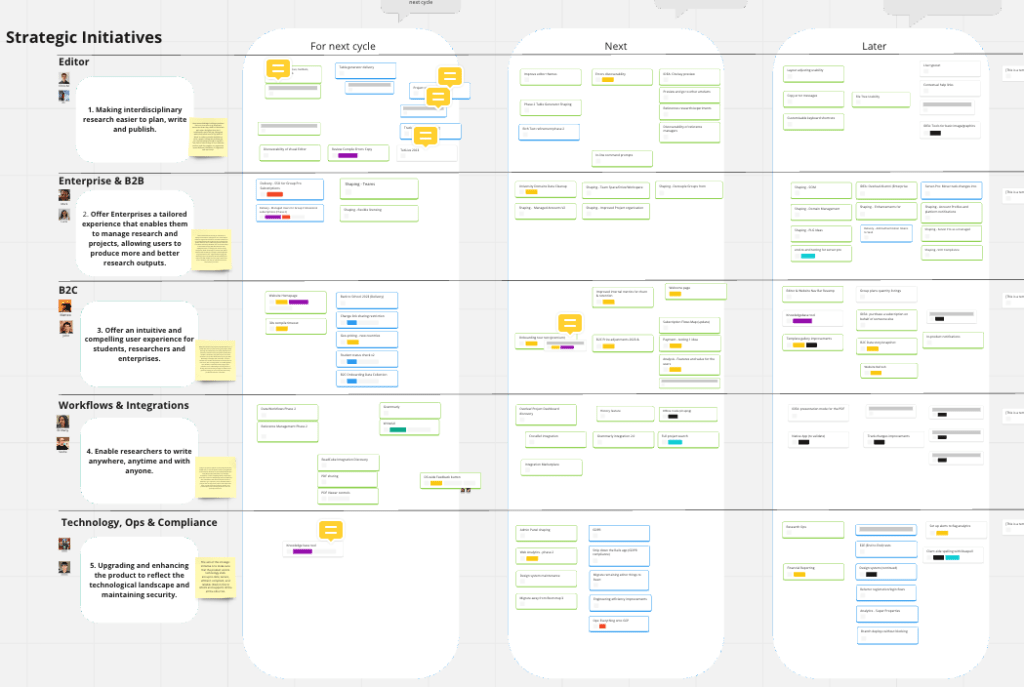
Partnering with the co-founders and executive team, we started from the vision to become the go-to place for scientific writing and worked backwards to define how we would get there based on market conditions, resources and the technical challenges that we had; I led on the development of a product strategy and articulated it into five strategic areas.
Hiring for success
At the same time as we developed the strategy, I started hiring to build cross-functional teams that could take ownership of these strategic initiatives. It was a gradual process that enabled us to grow organically while we established new systems. Our first hire was a highly skilled technical product manager who hit the ground running with our core editor, some months later we found an expert B2B product manager who immediately identified opportunities to grow our enterprise market, then came more talented PMs, UX-ers and Data Analysts of the same calibre.
What was our secret? We made sure that we had an inclusive and multidisciplinary panel to give us a 360 view on each candidate. My strongest skill in hiring is to read CVs beyond the headlines, considering candidates who might not have that “keyword” or specific job title but show a product mindset.
From strategy to delivery
To bring the strategy into delivery, we aligned the roadmap to our strategic initiatives and allocated cross-functional teams to each; we gave those teams the autonomy to own the problem space, develop their own strategy, make decisions and define their success metrics.
Finding a rhythm
Expanding a team also means that your calendars suddenly get filled with meetings, some of which become redundant. We got to a point where it was impossible to find focused time out of the weekly schedule; I took the initiative to assess and optimise our company ceremonies in relation to the product development cycles. We called it our “heartbeat” and it became the rhythm that carried us from 10M to 20M users. We kept growing 30-40% year-over-year, shipping major features, and became the most successful startup in our investors’ ecosystem.
Partnering with our Engineering Director, we introduced 6-week development cycles that were loosely inspired by the book Shape Up. We liked that this cadence was long enough to ship meaningful features, and short enough to pivot when necessary. More importantly, we added 2-week “cooldown” periods where everyone could surface, reflect, and plan without the pressure of constant delivery.
At the same time a cycle was running, we planned for the next one. Each team would come up with their own suggestions and we had dedicated forums to gather input from the rest of the business. When everyone knows what’s happening and why, when engineers understand how their work connects to user problems, when sales knows what’s coming next – everything moves faster. All of this was topped by demo days, IRL meetings and retrospectives that helped us grow and learn as a company.
Scaling user research operations
At the core of Overleaf’s values was a deep connection to their user community. The founders had dedicated themselves to understanding user needs through several research initiatives, and they had a solid understanding of the opportunity space. They had also managed to merge with their main competitor without causing major user disruptions.
When I joined I took the opportunity to build on their existing user-centric mindset. Starting from data from customer support queries, I began mapping user needs in different areas of the product to inform our roadmap direction; this process evolved over time and became a key part of our planning cycle, especially as the teams took ownership of their strategic initiatives.
To keep our product mindset sharp, I also introduced the practice of “continuous discovery”, training anyone from product to engineering, or sales to be confident to lead or actively observe user interviews; as the teams grew their confidence, we established a weekly cadence of user interviews, building opportunity maps, mapping and testing our assumptions when we had a solution to develop. This system all fit nicely within our product development heartbeat.
And before I forget, we documented EVERYTHING. This allowed new team members to get onboarded faster, and created a shared understanding between teams.
What I learned about scaling with intention
Over the course of three years, we developed an integrated system that covered product strategy, planning, delivery and continuous discovery, on top of growing a very talented multidisciplinary team that was able to work independently.
Whether you are a Founder just starting out or you are leading a growing team, these are some points to think about:
Product management helps founders multiply their impact. Overleaf started scaling well as we put systems in place to give teams autonomy and initiative. Founders were still involved in every aspect of the product, but they were no longer bottlenecks.
Growth doesn’t have to be chaotic. Making gradual changes in different areas of the company at the same time helps build organic systems that work well together. Documenting these processes as they evolve creates a shared understanding.
Diversity of thinking brings more impactful outcomes. From interviewing users, to understanding problems, shaping solutions and testing assumptions, having a variety of talent in the room minimises blind spots. It ultimately makes the process faster and more impactful.
Your best hires might already be in the building. Skills can be taught but values and beliefs rarely change, especially in mission-driven environments. Before you look outside of the company to hire, assess the talent in your team, be curious and open-minded. Is everyone in their happiest place?
When you hire externally, look for mindset over skills or job titles. In a world where everyone is using keywords to get through AI filters, look for signs of a product mindset. This could even be in the way they have designed their CV, the language they use, and the outcomes they describe. Did they show empathy for the user?
If you’re a founder feeling stretched between your vision, raising funds and delivering value to your users, I’d love to help you set your product operations up for success.
 RC Product